Due to the gradual perfection of student-centered classroom theory, this theory would be centered in practice. However, it would give a huge challenge to both teacher and students.
For students, they are only familiar with teacher-centered instruction, what kind of environment should teacher create for promoting student-centered learning. When facing evolution, how will students react to student-centered learning?
“Since the instructional design of student-centered classrooms is more fluid and unpredictable than teacher-centered classrooms, teachers require support in designing classes where they are no longer the sole knowledgeable authority figure to give students the skills and opportunity to work together to construct knowledge.”
Blanchard et al,2009
Additionally, from teacher-centered learning to student-centered learning, most students have little knowledge and skills to deal with the process of learning in student-centered classrooms successfully, because the student has to change the way they acquire knowledge, from value static knowledge to build knowledge through social interactions in an environment, such as in an inquiry setting.
Kelly’s classroom
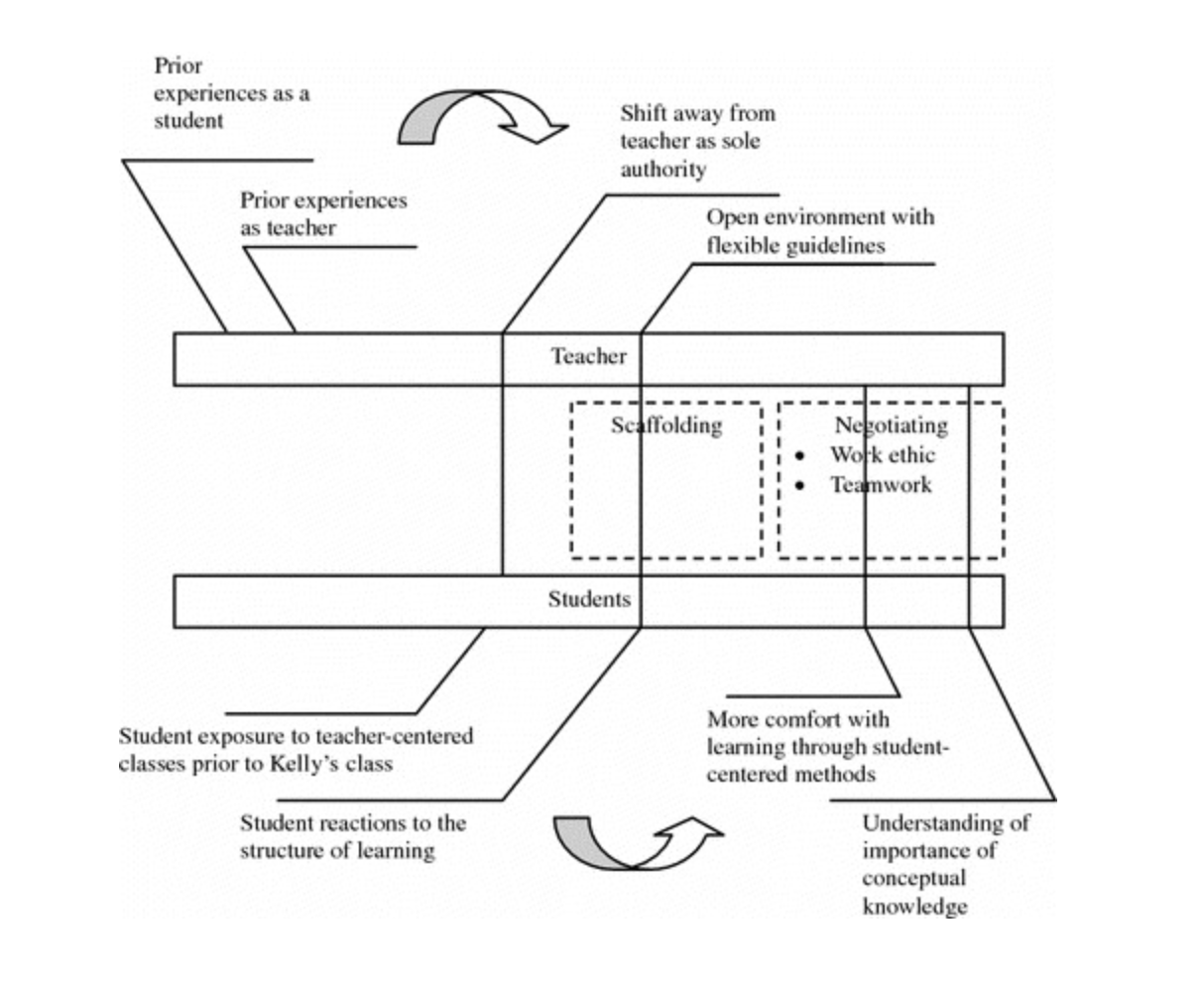
The researcher Peters(2010) create a case study, he asked a seventh-grade life science teacher, Kelly (a pseudonym), to promote a student-centered learning environment for students, then Peter collocate data via observation and tests,the teacher scaffolding and negotiation are the key approaches to help both to through from teacher-centered classroom to student-centered classroom. He made a parallel timeline of teacher and students orientations to student-centered methods as Figure 1, the large curved arrow represents a turning point.
Implications
During student-centered classroom, the teacher has to shift from solo authority to monitor, for Kelly, it is not easy to change the role, she experienced almost one year to find an appropriate model for students via observation and reflection. The environment, student choice, and teacher scaffolding are essential points for promoting student-centered classroom.
An interactive classroom environment
The teacher could create an interactive classroom environment for students to be familiar with student-centered learning, a well-designed classroom environment helps students integrate into new learning styles. Teachers can design tasks that make students interdependent and motivate them to continue to work towards a common goal. Meanwhile, tasks that emphasize student interaction can be designed and allow them to peer review, which can increase students’ sense of responsibility in learning.
Student choice
Student choice is also important, the student could choice own method or materials, which helps foster a sense of ownership. Teacher have to make balance between the student choice and freedom, the students could have freedom to choose which topic and approach to learn and the way of finding answers, moreover, teacher have to ask question related to selected topics to help student to seek answers.
“Scaffolding is the process of explicit teaching that provides large amounts of instructional support then decreases the amount of support to students until they can independently conduct more of their own learning.”
Hogan & Pressley, 1997
Teacher scaffolding
Scaffolding is familiar with the Zone of Proximal Development, which is the key to the success of Kelly’s classroom. Kelly could carefully monitor the group by asking the question to make sure learning process are under control, also she can develop a sense of student prior knowledge from which she could ask individuals questions that would advance student learning via interacting frequently. Meanwhile, Kelly make a balance between structure and freedom, because teachers give the question which is related to learning, and students have the freedom to seek the answers. With help from her understanding of student prior knowledge and probing questions, students could learn to an advanced level.
As a new teacher who are not familiar with student-centered classroom, we could find inspiration from Kelly’s classroom, utilizing environment, student choice, teacher scaffolding fully for facing the changeless.
Sources:
Blanchard, M. R., Southerland, S. A., & Granger, E. M. (2009). No silver bullet for inquiry: Making sense of teacher change following an inquiry‐based research experience for teachers. Science Education, 93(2), 322-360.
Hogan, K. E., & Pressley, M. E. (1997). Scaffolding student learning: Instructional approaches and issues. Brookline Books.
| Peters, E. E. (2010). Shifting to a student-centered science classroom: An exploration of teacher and student changes in perceptions and practices. Journal of Science Teacher Education, 21(3), 329-349. |

 Yanxi SHEN