Our education system lacks the ability to handle the emergency of disaster(earthquake, flooding and epidemic disease), the arrival of this disaster will add to the injustice of education. Before 2008, Chinese schools had no psychology teachers. It was not until the Wenchuan earthquake in 2008 that the Chinese government realized the importance of psychology teachers.The whole plan is not a complete action plan, the actual plan should be expanded on the basis of this framework according to the actual situation of each region. The whole program is for junior high school, they clearly know the meaning of disaster and can respond to the threat of disaster at the same time. The whole plan is divided into 2 parts.
Part 1
The first one is about the way to improve traditional education, releasing the anxiety of students and satisfying their safety needs is the key point.Some disasters focus on having a direct impact on the safety of the lives of people in a region, giving people living in bordering areas a sense of crisis. I remember the 2008 Wenchuan Earthquake in China, where my province bordered on Sichuan Province. When the earthquake struck, I could feel the quake.Therefore, I deeply feel the impact of the earthquake on my study, because my classroom in the second year of high school is on the 4th floor, which makes me scared every day.
Therefore, psychological pressure on students for such disasters requires the intervention of outside personnel, such as teachers and parents.If the teacher does not deal with the experience in this way, the relevant knowledge of the teacher and parents needs to be improved.To enhance the knowledge of teachers and parents requires the close cooperation of teachers and parents and the help of schools and communities.Regarding the improvement of the knowledge of teachers and parents, I introduced the concept of the key teacher, the term “key teachers” is used to refer to groups of educators, usually school vice-principals or district education officers, such teachers have the right to modify the curriculum( Sharma, 2018).
The key teacher’s embedded professional development framework can avoid the waste of human resources and money. Compared with experts, the key teacher has a better grasp of the actual situation, so that the problem can be solved according to the actual situation.The professional development structure is as follows;
- The school should form an alliance with other schools, seek help from the government, and let the government send corresponding experts to train teacher and parents .
- The experts train the key teacher sent by each school. The training content can include how to release pressure, how to observe students’ emotions, how to design psychological reconstruction courses, etc.
- The key teacher provides other teachers and parents with relevant guidance and training based on their school environment.
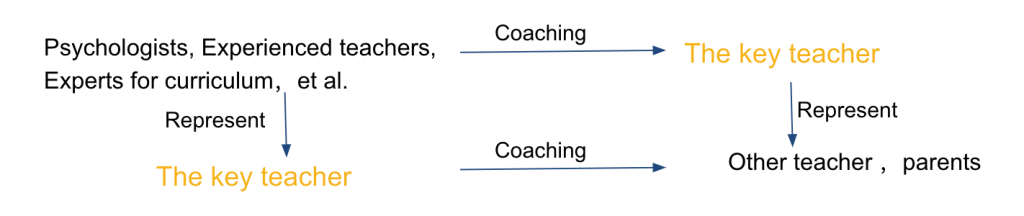
The coaching process
- Choose the skills and related experts
- Key teacher and education expert observe lessons by classroom teachers
- Key teacher observes the coaching process demonstrated by the expert
- Key teacher observes classroom teacher and practices coaching skills
- Key teachers and classroom teachers discuss learning (Sharma, 2018)
Part 2
When we have a disaster that affects people on a large scale,such as COVID-19, so we have no choice but to online education. This is the reason why the second part would talk about the online class, focusing on improving the quality of the online class and let each student get a chance to have an online class.
Because of internet or basic facilities, children cannot get education in online classrooms, and In Ontario, rural families cannot get opportunities for online classroom learning because of the Internet.The promotion of online education is limited by family income, for low-income families, who are unable to purchase the corresponding educational equipment(computer, network). The government plays an important part, The government should classify according to household income and set up corresponding plans according to different levels.
Problem 1
Unable to pay for network or education equipment, computer or mobile phone merchants can carry out rental activities.
Solution 1
The coverage of mobile phone signal base stations is wider than that of network optical fiber, and it has stable network speed, which can provide reliable online teaching. China’s telecommunications manufacturers and some applications have had special mobile phone traffic services.This service is free of charge for users who use the promotional application throughout the month.Therefore telecommunications manufacturers can carry out monthly activities that do not limit traffic for an educational application.
Problem 2
Living in the suburbs and unable to get a stable network, the teacher can record the lesson in advance.
Solution 2
The student learns through video the teacher communicates with the student online, the teacher arranges the homework through voice, and the voice interaction replaces the video interaction. Teachers and students can watch the recorded video at the same time. Teachers can also design classroom interactions in the video. When it comes to classroom interaction, teachers can use Message or mobile phone multi-party voice conversations to communicate.
For some families, the infrastructure for online courses is available, but the online classroom content designed by the teachers is not suitable, these families reject the online courses offered by the school.The families just want to improve the quality of online education, parents and teachers play an important role. The teachers are familiar with traditional education, so they do not know how to apply the right teaching method on the internet.Therefore, teachers need the help of peers or experts. For the process of improving professional abilities, please refer to “The professional development structure” I suggested above.
Teaching methods
Online courses are different from traditional education. Traditional education requires teachers and students to communicate face-to-face. Teachers can act as guardians and supervise student learning. In online learning, the role of teachers as supervisors is weakened.
Therefore, the teacher should know the student needs, when the teacher really understands the needs of the child, he can know how to guide the students, so that the needs can be transformed into the internal driving force of learning, and gradually make the students interested in team learning.Even without teacher supervision, children can learn independently.
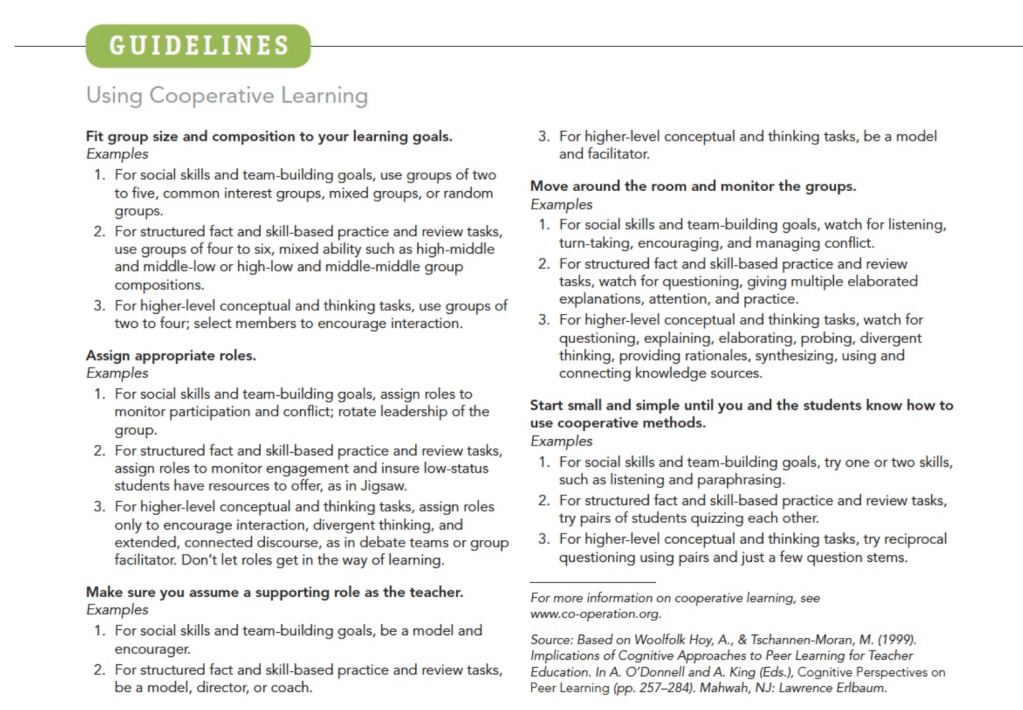
The teacher could combine the student-centered teaching method with the digital world, find an attractive way to show the knowledge to the student. In the student-centered teaching method, cooperative learning can also allow students to help each other learn while the teacher acts as a guide The role.If a teacher wants to design positive cooperative learning, the “Jigsaw classroom “could give him some inspirations, which the learning material is divided serval parts, and each student could be an expert in own part and teacher his group members via group work (Aronson,2000, p.173).
Other researchers (Woolfolk &Tschannen-Moran,1999) also announces some suggestions to avoid the disadvantage of group work, the advice is as Figure 1.
Content design & Parents
Not all content is suitable for use in online courses, so teachers should choose the appropriate content for teaching, and when designing the course, you need to consider the weakening of the teacher’s influence on the entire course, and also consider the role of parents in online courses. The task of the parents is to replace the teacher with the child in face-to-face communication, and always pay attention to the child’s feedback on the task, give back to the teacher, let the teacher modify the content of their course in time, so that the content is more in line with the child’s cognitive development.
For example,Physical education classes are not suitable for online teaching. In China, there are many jokes in the sports online class during the New Coronary Pneumonia. At this time, parents can give feedback to teachers so that teachers can improve their teaching content at any time, such as doing something more suitable. According to age, you can refer to parent-child yoga or single yoga.
Assessment
Comparing online education and traditional education, the biggest difference is the assessment, because teachers cannot objectively evaluate the performance of students, because in traditional courses, teachers and students communicate face-to-face. In online courses, students can skip classes in various ways, and they can also prove that they are in class, such as students blocking the camera with pictures. Therefore, it is a very difficult problem to evaluate students.
First of all, I want to introduce the mastery learning theory. The purpose of this method is to enable the child to better grasp the learning content and lead the child to personalized learning. Mastery learning theory ensures that students can learn from a unit only after they have mastered enough knowledge.Figure 2 shows Mastery learning, and the video could explain it.
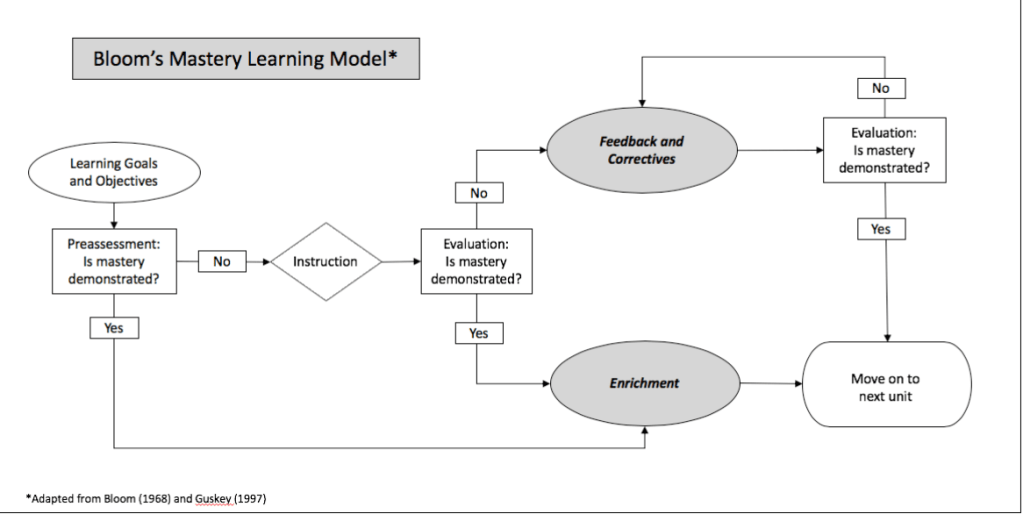
How to apply mastery learning theory in the current course, here I will introduce learning management system,and teacher should use the learning management system to help teacher supervisor the learning process, learning management system divides the whole curriculum into small pieces, with quizzes in each section. If the student passes the test, the next step could be taken, the teacher could intervene to help the students learn better when a student fails the test. The system could let students learn the courses step by step, build the learning ability.The video from 10:30 ,it could introduce the learning management system.
References
Sharma, U. (2018, May 24). Preparing to Teach in Inclusive Classrooms. Oxford Research Encyclopedia of Education. Retrieved 15 Feb. 2020, Retrieved from https://oxfordre.com/education/view/10.1093/acrefore/9780190264093.001.0001/acrefore-9780190264093-e-113.
Aronson, M. L. (200o). Nobody Left to Hate: Teaching Compassion after Columbine. New York,NY:Worth
Woolfolk Hoy, A., & Tschannen-Moran, M. (1999). Implications of cognitive approaches to peer learning for teacher education. Cognitive perspectives on peer learning, 257-284

 Yanxi SHEN