GSE500 Final project—Yanxi Shen

Our education system lacks the ability to handle the emergency of disaster(earthquake, flooding and epidemic disease), the arrival of this disaster will add to the injustice of education. Before 2008, Chinese schools had no psychology teachers. It was not until the Wenchuan earthquake in 2008 that the Chinese government realized the importance of psychology teachers.The whole plan is not a complete action plan, the actual plan should be expanded on the basis of this framework according to the actual situation of each region. The whole program is for junior high school, they clearly know the meaning of disaster and can respond to the threat of disaster at the same time. The whole plan is divided into 2 parts.

Part 1

The first one is about the way to improve traditional education, releasing the anxiety of students and satisfying their safety needs is the key point.Some disasters focus on having a direct impact on the safety of the lives of people in a region, giving people living in bordering areas a sense of crisis. I remember the 2008 Wenchuan Earthquake in China, where my province bordered on Sichuan Province. When the earthquake struck, I could feel the quake.Therefore, I deeply feel the impact of the earthquake on my study, because my classroom in the second year of high school is on the 4th floor, which makes me scared every day.

Therefore, psychological pressure on students for such disasters requires the intervention of outside personnel, such as teachers and parents.If the teacher does not deal with the experience in this way, the relevant knowledge of the teacher and parents needs to be improved.To enhance the knowledge of teachers and parents requires the close cooperation of teachers and parents and the help of schools and communities.Regarding the improvement of the knowledge of teachers and parents, I introduced the concept of the key teacher, the term “key teachers” is used to refer to groups of educators, usually school vice-principals or district education officers, such teachers have the right to modify the curriculum( Sharma, 2018).

The key teacher’s embedded professional development framework can avoid the waste of human resources and money. Compared with experts, the key teacher has a better grasp of the actual situation, so that the problem can be solved according to the actual situation.The professional development structure is as follows;

  •  The school should form an alliance with other schools, seek help from the government, and let the government send corresponding experts to train teacher and parents . 
  • The experts train the key teacher sent by each school. The training content can include how to release pressure, how to observe students’ emotions, how to design psychological reconstruction courses, etc.
  • The key teacher provides other teachers and parents with relevant guidance and training based on their school environment.                          
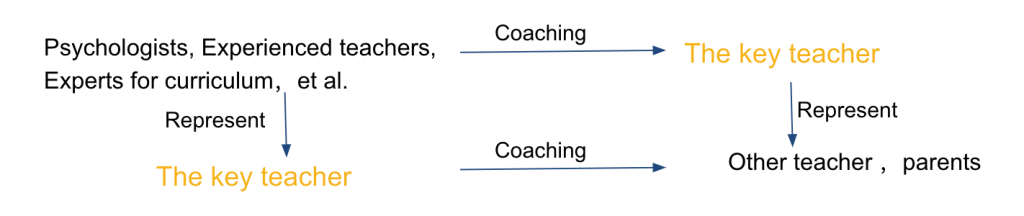
The professional development structure

The coaching  process

  1. Choose the skills and related experts
  2. Key teacher and education expert observe lessons by classroom teachers
  3. Key teacher observes the coaching process demonstrated by the expert
  4. Key teacher observes classroom teacher and practices coaching skills
  5. Key teachers and classroom teachers discuss learning (Sharma, 2018)

Part 2

When we have a disaster that affects people on a large scale,such as COVID-19, so we have no choice but to online education. This is the reason why the second part would talk about the online class, focusing on improving the quality of the online class and let each student get a chance to have an online class. 

Because of internet or basic facilities, children cannot get education in online classrooms, and In Ontario, rural families cannot get opportunities for online classroom learning because of the Internet.The promotion of online education is limited by family income, for low-income families, who are unable to purchase the corresponding educational equipment(computer, network). The government plays an important part, The government should classify according to household income and set up corresponding plans according to different levels.

Problem 1

Unable to pay for network or education equipment, computer or mobile phone merchants can carry out rental activities. 

Solution 1

The coverage of mobile phone signal base stations is wider than that of network optical fiber, and it has stable network speed, which can provide reliable online teaching. China’s telecommunications manufacturers and some applications have had special mobile phone traffic services.This service is free of charge for users who use the promotional application throughout the month.Therefore telecommunications manufacturers can carry out monthly activities that do not limit traffic for an educational application.

Problem 2

Living in the suburbs and unable to get a stable network, the teacher can record the lesson in advance.

Solution 2

The student learns through video the teacher communicates with the student online, the teacher arranges the homework through voice, and the voice interaction replaces the video interaction. Teachers and students can watch the recorded video at the same time. Teachers can also design classroom interactions in the video. When it comes to classroom interaction, teachers can use Message or mobile phone multi-party voice conversations to communicate.


For some families, the infrastructure for online courses is available, but the online classroom content designed by the teachers is not suitable, these families reject the online courses offered by the school.The families just want to improve the quality of online education, parents and teachers play an important role. The teachers are familiar with traditional education, so they do not know how to apply the right teaching method on the internet.Therefore, teachers need the help of peers or experts. For the process of improving professional abilities, please refer to “The professional development structure” I suggested above.

Teaching methods

Online courses are different from traditional education. Traditional education requires teachers and students to communicate face-to-face. Teachers can act as guardians and supervise student learning. In online learning, the role of teachers as supervisors is weakened.

Therefore, the teacher should know the student needs, when the teacher really understands the needs of the child, he can know how to guide the students, so that the needs can be transformed into the internal driving force of learning, and gradually make the students interested in team learning.Even without teacher supervision, children can learn independently.

The teacher could combine the student-centered teaching method with the digital world, find an attractive way to show the knowledge to the student. In the student-centered teaching method, cooperative learning can also allow students to help each other learn while the teacher acts as a guide The role.If a teacher wants to design positive cooperative learning, the “Jigsaw classroom “could give him some inspirations, which the learning material is divided serval parts, and each student could be an expert in  own part and  teacher his group members via group work (Aronson,2000, p.173).

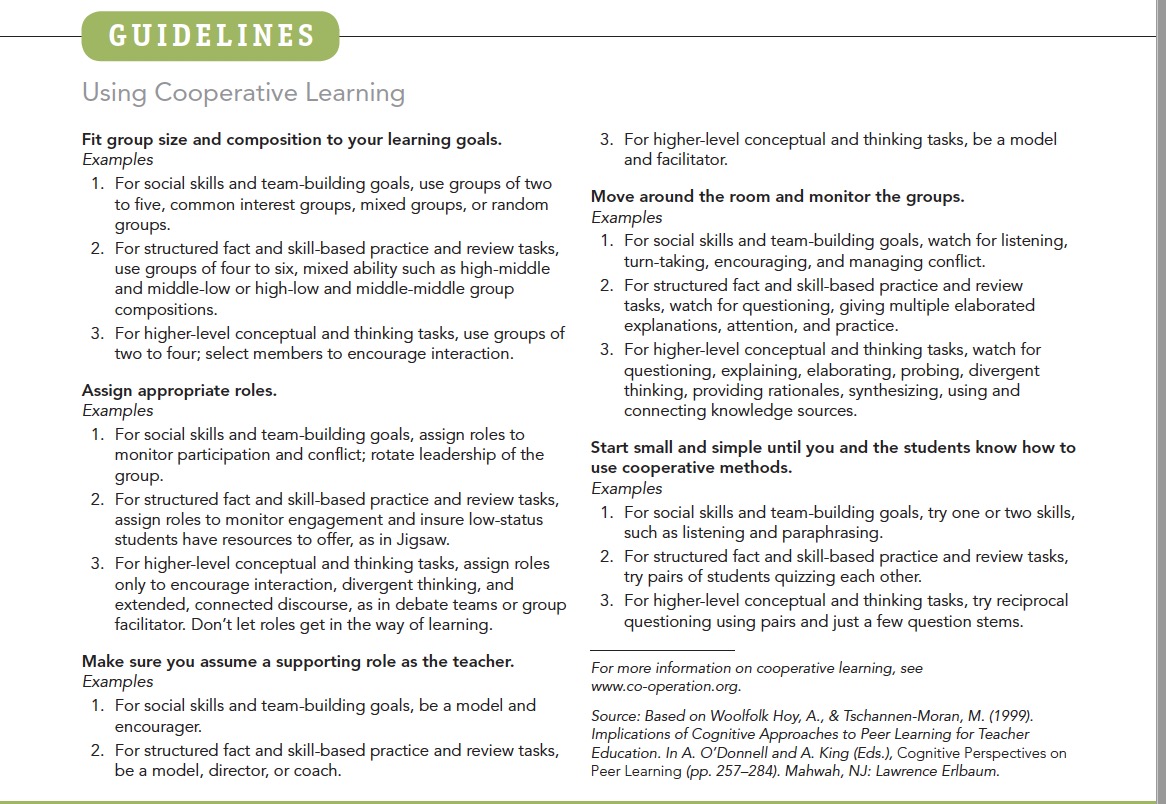
Other researchers (Woolfolk &Tschannen-Moran,1999) also announces some suggestions to avoid the disadvantage of group work, the advice is as Figure 1.
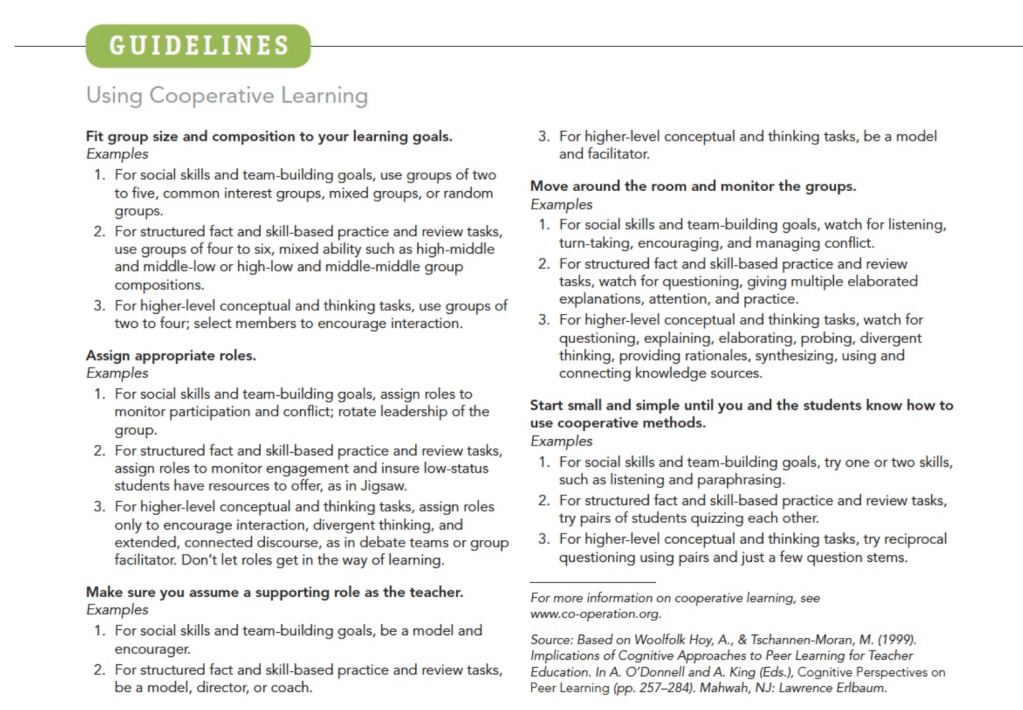
Figure 1

Content design & Parents

Not all content is suitable for use in online courses, so teachers should choose the appropriate content for teaching, and when designing the course, you need to consider the weakening of the teacher’s influence on the entire course, and also consider the role of parents in online courses. The task of the parents is to replace the teacher with the child in face-to-face communication, and always pay attention to the child’s feedback on the task, give back to the teacher, let the teacher modify the content of their course in time, so that the content is more in line with the child’s cognitive development. 

For example,Physical education classes are not suitable for online teaching. In China, there are many jokes in the sports online class during the New Coronary Pneumonia. At this time, parents can give feedback to teachers so that teachers can improve their teaching content at any time, such as doing something more suitable. According to age, you can refer to parent-child yoga or single yoga.

Assessment

Comparing online education and traditional education, the biggest difference is the assessment, because teachers cannot objectively evaluate the performance of students, because in traditional courses, teachers and students communicate face-to-face. In online courses, students can skip classes in various ways, and they can also prove that they are in class, such as students blocking the camera with pictures. Therefore, it is a very difficult problem to evaluate students.

First of all, I want to introduce the mastery learning theory. The purpose of this method is to enable the child to better grasp the learning content and lead the child to personalized learning. Mastery learning theory ensures that students can learn from a unit only after they have mastered enough knowledge.Figure 2 shows Mastery learning, and the video could explain it.
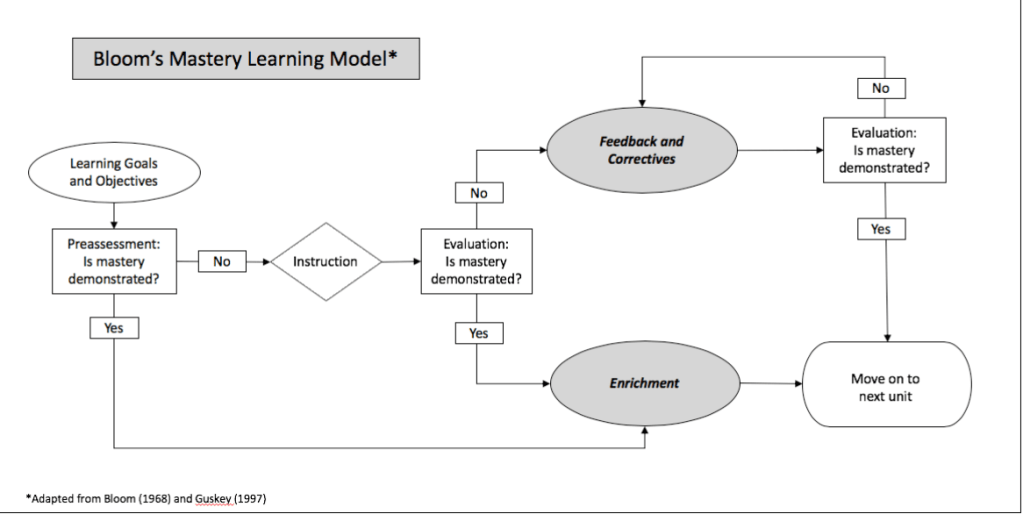
Figure 2 Mastery learning

How to apply mastery learning theory in the current course, here I will introduce learning management system,and teacher should use the learning management system to help teacher supervisor the learning process, learning management system divides the whole curriculum into small pieces, with quizzes in each section. If the student passes the test, the next step could be taken, the teacher could intervene to help the students learn better when a student fails the test. The system could let students learn the courses step by step, build the learning ability.The video from 10:30 ,it could introduce the learning management system.

References

Sharma, U.  (2018, May 24). Preparing to Teach in Inclusive Classrooms. Oxford Research Encyclopedia of Education. Retrieved 15 Feb. 2020, Retrieved from https://oxfordre.com/education/view/10.1093/acrefore/9780190264093.001.0001/acrefore-9780190264093-e-113.

Aronson, M. L. (200o). Nobody Left to Hate: Teaching Compassion after Columbine. New York,NY:Worth

Woolfolk Hoy, A., & Tschannen-Moran, M. (1999). Implications of cognitive approaches to peer learning for teacher education. Cognitive perspectives on peer learning, 257-284
The teacher is key to the success of student-centered classroom

Researchers find that the environment, scaffolding, and student choice are three significates for student-centered learning(Peters,2010), meanwhile, the teacher plays an important role within the student-centered classroom .

In the environment, the teacher has to design appropriate tasks to guide students to seek answers for raising the sense of responsibility in learning. About scaffolding, it is no doubt that the teacher holds this part, because the teacher helps the student to pass the transition time, helping the student to transfer smoothy from needing teachers’ aid to learning independently . Meanwhile, the student has own choice to choose which topic and method to learn under teachers’ control.

For the student, the student-centered classroom is a new type of learning, so does the teacher, it is a huge challenge for the teacher, what skills and attitudes teachers need in this types of environment?

Confidence

Facing the various challenges, the teacher has to be confident about his decision and behaviours of students, so how do we cultivate the confidence of the teacher? We could concern about nonverbal cues (Cuddy,2002), she found inspirations from the animal world. She named the stretching body as high-power poses, in the opposite way, curling up body is low-power poses. The results is the high-power poses could increase confidence and decrease anxiety because of the hormone. We could encourage the teacher to do more high-power poses before making a decision, it could help them to be confidence about decision what they made.  

Observation

Observation is also an important feature for the teacher, because the student is an active role in the student-centered classroom, it does not mean teacher transfer rights to students, so the teacher has to supervise the process of learning. Even though group work has advantages, it still has disadvantages without control of the teacher, such as the student would transfer their dependence on teachers to their peers, moreover(Rohrkemper,1989). The teacher should observe group work carefully to make sure the process of cooperative learning is under control.

How do we improve the observation of teacher? I suggest “peer review”, new teacher, not familiar with student-centered classroom, could observe the class of colleagues who are more capable with student-centered classroom, then they could share experiences after class, it could help new teacher expand observation in breadth and depth via comparison and communication.

Reflection

Compared with teacher-centered learning theory, student-centered learning theory belongs to new learning theory that is still being explored, so we will face many failures and challenges when we apply student-centered class from theory to practice, it is the reason why reflection shows significant influence on the teacher when facing or avoiding mistakes.

Reflection can be divided into self-reflection and reflection from others. About self-reflection, the teacher can sum up their work experiences every day to find out the advantages and disadvantages so as to record. As reflection from others, we could concern about “peer review”, the teacher could interview people such as colleagues, parents to listen class for getting advice, also teacher could make an open mailbox to the outside world.

Sources:

Cuddy, A. (2015). Presence: Bringing your boldest self to your biggest challenges. Hachette UK.

Rohrkemper, M. M. (1989). Self-regulated learning and academic achievement: A Vygotskian view. In Self-regulated learning and academic achievement (pp. 143-167). Springer, New York, NY.

Peters, E. E. (2010). Shifting to a student-centered science classroom: An exploration of teacher and student changes in perceptions and practices. Journal of Science Teacher Education, 21(3), 329-349.

What do we learn from Kelly’s classroom?

Due to the gradual perfection of student-centered classroom theory, this theory would be centered in practice. However, it would give a huge challenge to both teacher and students.

For students, they are only familiar with teacher-centered instruction, what kind of environment should teacher create for promoting student-centered learning. When facing evolution, how will students react to student-centered learning?

“Since the instructional design of student-centered classrooms is more fluid and unpredictable than teacher-centered classrooms, teachers require support in designing classes where they are no longer the sole knowledgeable authority figure to give students the skills and opportunity to work together to construct knowledge.”

Blanchard et al,2009

Additionally, from teacher-centered learning to student-centered learning, most students have little knowledge and skills to deal with the process of learning in student-centered classrooms successfully, because the student has to change the way they acquire knowledge, from value static knowledge to build knowledge through social interactions in an environment, such as in an inquiry setting.

Kelly’s classroom

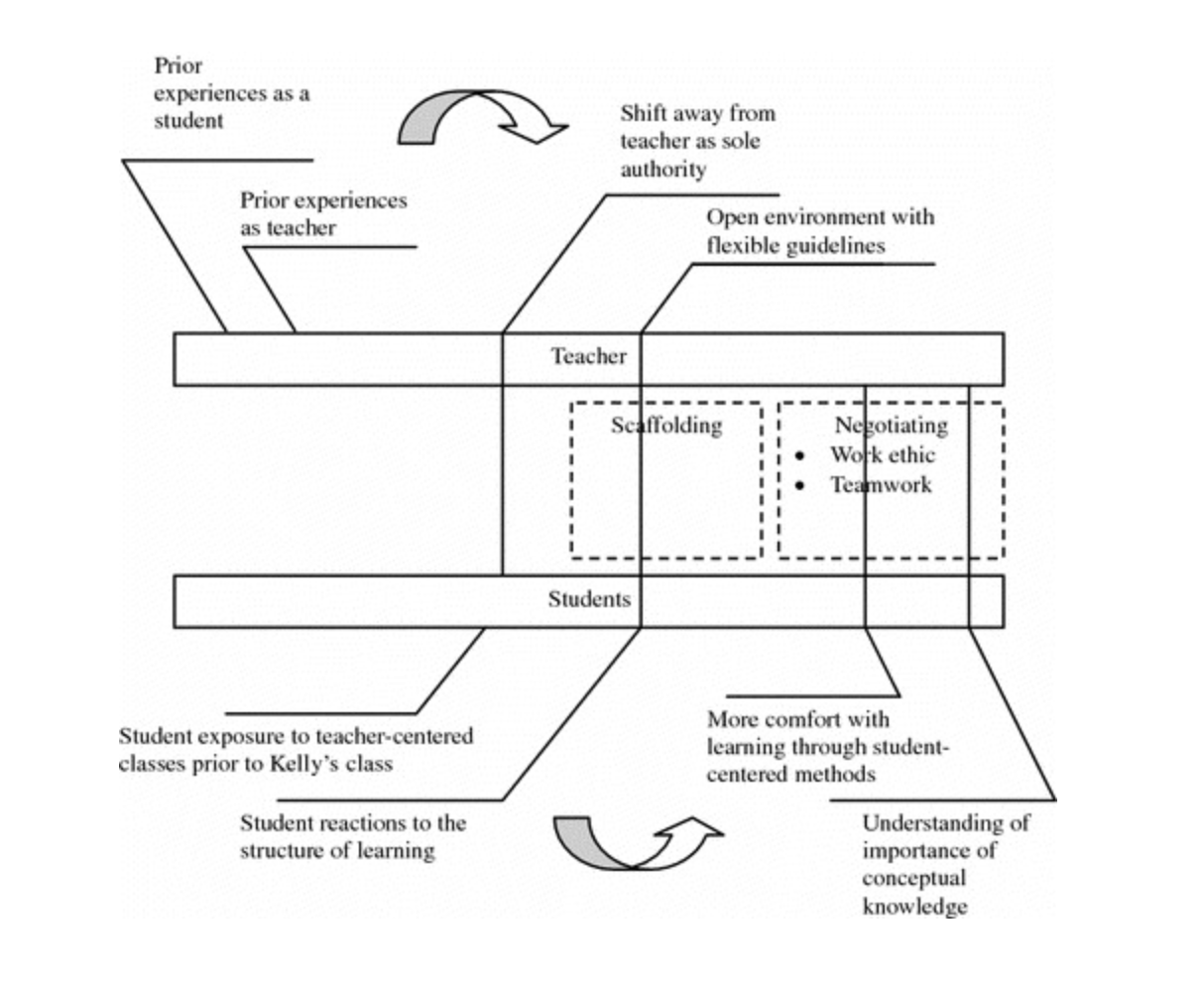
The researcher Peters(2010) create a case study, he asked a seventh-grade life science teacher, Kelly (a pseudonym), to promote a student-centered learning environment for students, then Peter collocate data via observation and tests,the teacher scaffolding and negotiation are the key approaches to help both to through from teacher-centered classroom to student-centered classroom. He made a parallel timeline of teacher and students orientations to student-centered methods as Figure 1, the large curved arrow represents a turning point.

Fig. 1 Parallel timeline of teacher and students orientations to student-centered methods

Implications

During student-centered classroom, the teacher has to shift from solo authority to monitor, for Kelly, it is not easy to change the role, she experienced almost one year to find an appropriate model for students via observation and reflection. The environment, student choice, and teacher scaffolding are essential points for promoting student-centered classroom.

An interactive classroom environment

The teacher could create an interactive classroom environment for students to be familiar with student-centered learning, a well-designed classroom environment helps students integrate into new learning styles. Teachers can design tasks that make students interdependent and motivate them to continue to work towards a common goal. Meanwhile, tasks that emphasize student interaction can be designed and allow them to peer review, which can increase students’ sense of responsibility in learning.

Student choice

Student choice is also important, the student could choice own method or materials, which helps foster a sense of ownership. Teacher have to make balance between the student choice and freedom, the students could have freedom to choose which topic and approach to learn and the way of finding answers, moreover, teacher have to ask question related to selected topics to help student to seek answers.

“Scaffolding is the process of explicit teaching that provides large amounts of instructional support then decreases the amount of support to students until they can independently conduct more of their own learning.”

Hogan & Pressley, 1997

Teacher scaffolding

Scaffolding is familiar with the Zone of Proximal Development, which is the key to the success of Kelly’s classroom. Kelly could carefully monitor the group by asking the question to make sure learning process are under control, also she can develop a sense of student prior knowledge from which she could ask individuals questions that would advance student learning via interacting frequently. Meanwhile,  Kelly make a balance between structure and freedom, because teachers give the question which is related to learning, and students have the freedom to seek the answers. With help from her understanding of student prior knowledge and probing questions, students could learn to an advanced level.

As a new teacher who are not familiar with student-centered classroom, we could find inspiration from Kelly’s classroom, utilizing environment, student choice, teacher scaffolding fully for facing the changeless.

  Sources:

Blanchard, M. R., Southerland, S. A., & Granger, E. M. (2009). No silver bullet for inquiry: Making sense of teacher change following an inquiry‐based research experience for teachers. Science Education93(2), 322-360.

Hogan, K. E., & Pressley, M. E. (1997). Scaffolding student learning: Instructional approaches and issues. Brookline Books.

Peters, E. E. (2010). Shifting to a student-centered science classroom: An exploration of teacher   and student changes in perceptions and practices. Journal of Science Teacher Education21(3), 329-349.

The different perspective in applying the student- centered teaching method

Student- centered teaching method focuses on learning from social interactions, so the cooperative learning-needs students to work together for accomplishing a goal, enjoys high popularity recently , it could help the student expand their knowledge, and have ownership of learning.

The role of the teacher in the student- centered classroom

Student- centered classroom concerns about students’ learning needs and makes the role of student active in the learning process, but it does not mean teachers can ignore students’ learning without guiding them, because the teacher still plays an important role in the student- centered classroom. Without the guidance of the teacher in the student- centered classroom, the shortcomings of cooperative learning will appear.

For example , students would value process over the learning, which means students could focus on the speed of the process rather than thoughtfulness and learning, some students could pay attention to socializing and interpersonal relationship over the learning, also students could transfer their dependence on teachers to their peers, moreover, once a student lose support in the group, the attitude of students would be worse(Rohrkemper,1989).

Applying cooperative learning

If a teacher wants to design positive cooperative learning, the “Jigsaw classroom “could give him some inspirations, which the learning material is divided serval parts, and each student could be an expert in own part and teacher his group members via group work (Aronson,2000, p.173).

Other researchers (Woolfolk &Tschannen-Moran,1999) also announces some suggestions to avoid the disadvantage of group work, the advice is as Figure 1.

Student-centered teaching method in the digital world

Due to the popularity of science and technology, the way of learning presents diversified development, cooperative learning evolved into personalized learning. Educator creates Learning management system (LMS) to observe the performance of students in the internet, teacher could use virtual learning environment (VLE) to help students to build personal learning environment (PLE) thus form personal learning network (PLN) online.

Khan Academy is kind of LMS, created by a teacher whose name Salman Khan, which proves series of educational videos(VLE) with the complete curricula in kinds of subjects, so students could learn it by own step online (PLE), also student could form support groups, and share knowledge via cooperation(PLN).

With help from technology, student- centered classroom evolved into many forms, the class would not be boring because of VLE, which could help students raise the motivation of learning . The students would willing to learn once having motivation, they could do cooperative learning by internet online, for example, Chinese students could share knowledge with Canadian student in internet. Meanwhile, the teacher’s role is transferred from the sole authority to the monitor of students, which helps teachers have more private space and avoid burnout.

Sources:

Rohrkemper, M. M. (1989). Self-regulated learning and academic achievement: A Vygotskian view. In Self-regulated learning and academic achievement (pp. 143-167). Springer, New York, NY.

Aronson, M. L. (200o). Nobody Left to Hate: Teaching Compassion after Columbine. New York,NY:Worth

Woolfolk Hoy, A., & Tschannen-Moran, M. (1999). Implications of cognitive approaches to peer learning for teacher education. Cognitive perspectives on peer learning, 257-284
Constructivism and student-centered teaching method

Constructivism is a learning theory widely used in the 21st century, which emphasizes learner are active and social interaction play an important role in leaning(Bruning, Schraw,&Norby,2011).

The development of Constructivism

The development of Constructivism is divide two periods, the first stage called First wave constructivism, which is announced by Piaget(1896-1980), a famous psychologist.Piaget’s psychological(cognitive) constructivism concern about individual perspective, and Piaget believed in the logical and construction of  universal knowledge that can not be learned by environment(Mlller,2011), moreover, Piaget believes in social transmission is an essential part but could not affect people deeply(Moshman,1997), and the first wave constructivism can expand on “Radical constructivism”- knowledge is assumed to be the individual’s construction, it cannot be judged right or wrong(Woolfolk,2016).

Piaget’s constructivism theory

The second stage called “Second wave constructivism” which mainly is consisted of “Vygotsky(1896-1934)’ s social constructivism”. “Vygotsky’s social constructivism” believed in development and learning are shaped by social interaction, culture tools, and activities. It could bond physical constructivism and social constructivism, for example, “The zone of proximal development” is an area that children could solve the problem with help from who it is more capable of knowledge ,and is also a place culture and cognitive interact with each other(Cole,1985).

The student-centered teaching method in constructivistivism

There are various types of learning theories in the constructivism, however, they still get focal characteristics influences all learning on the constructivist model  , which are displayed in Figure 1 (Brunning, Schraw, & Ronning,1995).

            Figure 1. Focal characteristics of constructivism.

Figure 1. Focal characteristics of constructivism.

The student-centered teaching method is one of constructivist theories, which is the mainstream view in the pedagogy recently, it could give students kinds of a chance to learn, because Student-centred class is dynamic construction of knowledge and students could learn it from social interactions by culture tools.

In constructivism, the student-centered classroom could build “Complex learning environments”-“problem and learning situation that mimic the ill-structured nature of real life(Woolfolk,2016)” for students and give them authentic tasks to accomplish. Then, students could learn knowledge from peers or teachers via social negotiation-one of social interactions. It also emphasizes making students build awareness of active learning role.

Sources:

Brunning, R. H., G. J. Schraw, and R.R.Ronning. 1995. Cognitive psychology and

      instruction, 2nd edition. Englewood Cliffs, NJ: Prentice Hall.

Cole, M. (1985). The zone of proximal development-where culture and cognition

  create each other.

Miller, P. H. (2011). Theories of developmental psychology. Macmillan.

Moshman, D. (1997). Pluralist rational constructivism. Issues in Education, 

3(2), 229-233.

Woolfolk, A. (2016). Educational psychology (6th ed.). New Jersey: Pearson Education.

https://www.learning-theories.com/constructivism.html

https://en.wikipedia.org/wiki/Lev_Vygotsky

https://en.wikipedia.org/wiki/Jean_Piaget

https://www.edglossary.org/student-centered-learning/

Nonverbal Cues contributes to student-centered classroom

In ancient time, ancestors communicate in primitive ways, using body language or expressions. However, with the development of human beings, the language plays important parts in the communication gradually instead of the nonverbal ways.As the educators, we could use nonverbal cues to help us to guide students or help ourselves.

With the success of the American drama “lie to me“, which based on the famous psychologist Paul Ekman. more and more people are beginning to realize the importance of micro-expressions.

What are the Nonverbal Cues?

Hogan is the most famous American expert in persuasion psychology and interpersonal communication. giving us a definition of nonverbal communication. The nonverbal communication represents two-thirds of all communications; nonverbal communication can portray a message both vocally and with the correct body signals or gesture. Body signals comprise physical features, conscious and unconscious gestures and signals, and the mediation of personal space. (Hogan,2003)If you want to learn more about the sustainability degree, check here.

Why the Nonverbal Cues are important?

Daily communication

Nonverbal cues build contribution to daily communication. According to the studies from Australia body language experts, the couple Pease, mention that “when the other person or group is absorbing the message, they are focused on the entire environment around them, meaning the other person uses all five senses in the interaction: 83% sight, 11% hearing, 3% smell, 2% touch and 1% taste.” (Pease B. & Pease A.,2008). 

On the one hand, Nonverbal information can sometimes substitute for some linguistic information, people use the language to communicate, expressing feelings. However, it is difficult to communicate with people only via languages, so people need to use nonverbal behavior at the same time for auxiliary, making the intentions which have full and perfect expressions. 

On the other hand, a person’s understanding is largely based on the perception of their nonverbal behaviors, nonverbal cues could help us to express ourselves appropriately in the presence of the others, as well as to help us understand the information of the others, such as age, identity, status, interests, hobbies and emotions, these all can be expressed in nonverbal behaviors.

For the student-centered classroom, the teacher would use prior knowledge to give student question via communication to make sure student is under control, the way how teacher express would play an important role, so the teacher could use nonverbal cues to contribute discussion.

Adapt to the environment

The most obvious role of nonverbal cues is to enhance people’s relationships thus it could help people adapt themselves to the environment. The teacher could teach students how to use nonverbal cues to contributes adaption of environment.

In the study Children‘s facial and gestural decoding and encoding: Relations between skills and with popularity( Boyatzis & Satyaprasad, 1994). This study examined preschool children‘s decoding and encoding of facial emotions and gestures, interrelationships between these skills, and the relationship between these skills and children’s popularity, the researchers selection 34 preschoolers (eighteen 4-year-olds, sixteen 5-year-olds)with an equal number of boys and girls. they test four tasks(1. Decoding emotions, 2.Decoding gestures,3.Encoding facial emotions, 4. Encoding gestures.) via teacher ratings to measure the consequence. The multiple regression analyses indicated that encoding emotions and decoding gestures were marginally predictive of popularity. 

Modify personality

The nonverbal language also shapes the personality via body languages, which is one of the more common ways of communication, we normally use in consciously or unconsciously. As Amy Cuddy who is an American social psychologist eloquently pronounces behaviors from animals which could explain the reasons for human behaviors. 


In the animal world, when they want to expand their field or face threats, they stretch their bodies and increase their size to show they are powerful. It means that stretching body could make people more powerful. She points out the body movements which are low-power poses and high-power poses, this two kind of poses could change the brain, simulating brain to produce some hormones and then driving a reflection of people. 


The poses which need stretch bodies call high-power poses, and the opposite poses call low-power poses; the high-power poses could change the two hormones which are testosterone and cortisol. The highly successful people usually have high-level testosterone that increases feelings of confidence and low-level cortisol which can decrease anxiety and be an improved ability to deal with stress. 


If people do high-power poses at a high frequency, they hormones in their bodies will continue to maintain a certain level, which is high-level testosterone and low-level cortisol. Cuddy points out an assumption that the nonverbal movements could help people improve themselves, people could grain the information that the high-power posts could produce hormones which impact the physical part, then drive the mental part. (Cuddy,2015).This means that the change in behavior can change the hormones produced in the brain, and the changes in hormones keep behavior in a state, thus changing the personality.

“Fake it till you become it, do it enough until you actually become it and internalize, tiny tweaks can lead to big changes.”

Cuddy,2015

It is obvious that the nonverbal cues impact people life tremendously,since the nonverbal cues could help people to communicate well, mortify personality and dissimilate the atmosphere of the environment. It is no doubt that the nonverbal cues would be an indispensable part of people, so we could apply them in real life to improve relationships.

For the educator, nonverbal cues could give teachers a help ,which means teachers utilize nonverbal cues to upgrade their teaching approaches in details ,and let they are confident about decision, thus it could make the progress of student-centered classroom smoothy.


              If you want to know more about the speech of Amy Cuddy, please check the video.↓↓↓

Sources:

  1. The epic opening scene of Lie To Me.https://www.youtube.com/watch?v=bWyhsqh_e9s&
  2. Hogan, K.; Stubbs, R. (2003). Can’t get through:8 barriers to communication.Grenta, LA: Pelican Publishing Company, ISBN 978-1589800755
  3. Pease, B., & Pease, A. (2008). The definitive book of body language:   The hidden meaning behind people’s gestures and expressions.
  4. Boyatzis, C. J., & Satyaprasad, C. (1994). Children’s facial and gestural decoding and encoding: Relations between skills and with popularity. Journal of Nonverbal Behavior, 18(1), 37-55.
  5. Cuddy, A. (2015). Presence: Bringing your boldest self to your biggest challenges. Hachette UK.
  6. Dr. PaulEkman, PaulEkmangroup,2018,                           https://www.paulekman.com/about/paul-ekman/
  7. Amy Cuddy,2018,https://en.wikipedia.org/wiki/Amy_Cuddy
  8. Your body language shapes who you are – Amy Cuddy,TED,2013   https://www.youtube.com/watch?v=Ks-_Mh1QhMc