Student- centered teaching method focuses on learning from social interactions, so the cooperative learning-needs students to work together for accomplishing a goal, enjoys high popularity recently , it could help the student expand their knowledge, and have ownership of learning.
The role of the teacher in the student- centered classroom
Student- centered classroom concerns about students’ learning needs and makes the role of student active in the learning process, but it does not mean teachers can ignore students’ learning without guiding them, because the teacher still plays an important role in the student- centered classroom. Without the guidance of the teacher in the student- centered classroom, the shortcomings of cooperative learning will appear.
For example , students would value process over the learning, which means students could focus on the speed of the process rather than thoughtfulness and learning, some students could pay attention to socializing and interpersonal relationship over the learning, also students could transfer their dependence on teachers to their peers, moreover, once a student lose support in the group, the attitude of students would be worse(Rohrkemper,1989).
Applying cooperative learning
If a teacher wants to design positive cooperative learning, the “Jigsaw classroom “could give him some inspirations, which the learning material is divided serval parts, and each student could be an expert in own part and teacher his group members via group work (Aronson,2000, p.173).
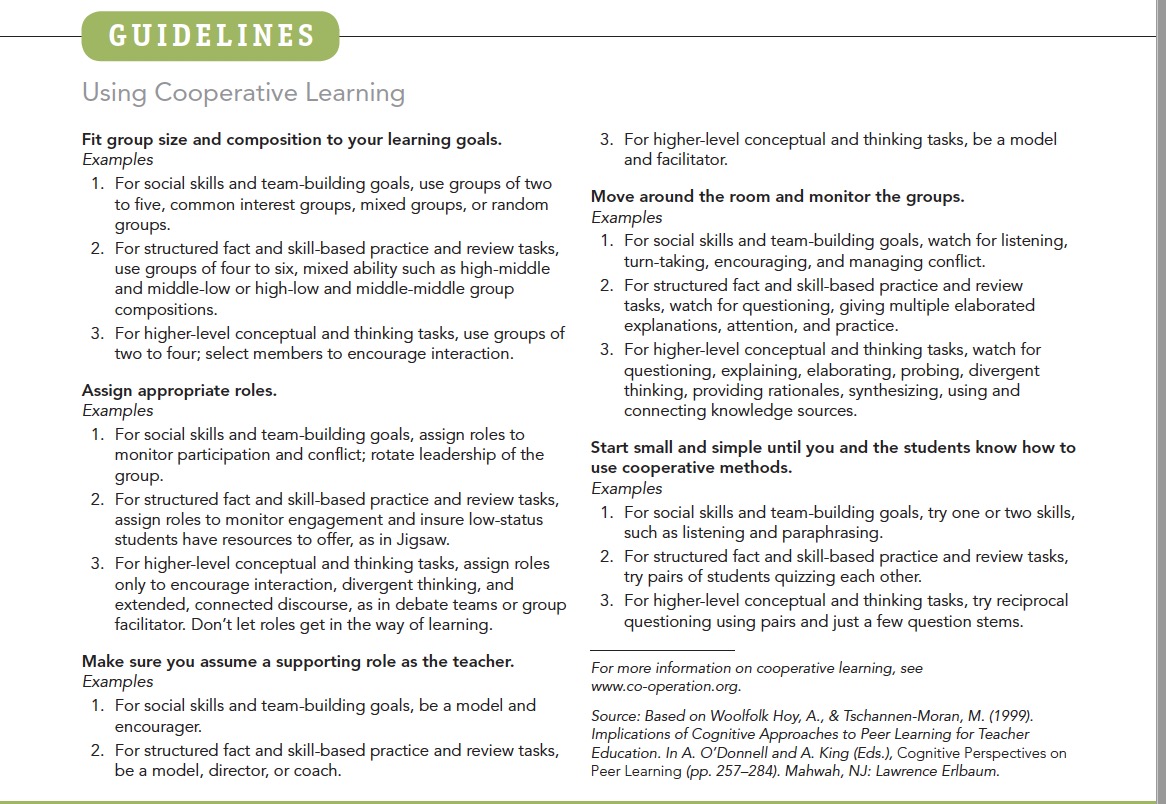
Other researchers (Woolfolk &Tschannen-Moran,1999) also announces some suggestions to avoid the disadvantage of group work, the advice is as Figure 1.
Student-centered teaching method in the digital world
Due to the popularity of science and technology, the way of learning presents diversified development, cooperative learning evolved into personalized learning. Educator creates Learning management system (LMS) to observe the performance of students in the internet, teacher could use virtual learning environment (VLE) to help students to build personal learning environment (PLE) thus form personal learning network (PLN) online.
Khan Academy is kind of LMS, created by a teacher whose name Salman Khan, which proves series of educational videos(VLE) with the complete curricula in kinds of subjects, so students could learn it by own step online (PLE), also student could form support groups, and share knowledge via cooperation(PLN).
With help from technology, student- centered classroom evolved into many forms, the class would not be boring because of VLE, which could help students raise the motivation of learning . The students would willing to learn once having motivation, they could do cooperative learning by internet online, for example, Chinese students could share knowledge with Canadian student in internet. Meanwhile, the teacher’s role is transferred from the sole authority to the monitor of students, which helps teachers have more private space and avoid burnout.
Sources:
Rohrkemper, M. M. (1989). Self-regulated learning and academic achievement: A Vygotskian view. In Self-regulated learning and academic achievement (pp. 143-167). Springer, New York, NY.
Aronson, M. L. (200o). Nobody Left to Hate: Teaching Compassion after Columbine. New York,NY:Worth
Woolfolk Hoy, A., & Tschannen-Moran, M. (1999). Implications of cognitive approaches to peer learning for teacher education. Cognitive perspectives on peer learning, 257-284

 Yanxi SHEN
I wanted to point out that cooperative learning is not really a student-centered strategy. Cooperative learning such as the jigsaw approach stem from a behaviouristic orientation. The ideas of individual accountability and group interdependence reflect structured approaches. Collaborative learning on the other hand or learning through real-world activity in participation with a more knowledgeable other (Bruner), this is from a more student-centered approach. Yes students are active while doing cooperative learning, but the specific structures are very teacher-led with the teacher predetermining the learning objectives and a focus on prior knowledge. Notice that similarly the Khan videos fall into a behaviouristic tradition — students learn through watching videos, at their own pace, and through practice. The use of the video can make people think it’s more radical, but it’s really just a series of lectures with practice sessions, something Skinner would highly approve of. It could also be associated with cognitivism, as the idea is that the expert is transmitting knowledge. The VLE is more student-centered as an idea.
LikeLike
Student-centered teaching ideas are more conducive to the development of students’ individuality. Each person’s talent is different. The teacher-centered education method is not conducive to the talents of the students and will kill the children’s nature.
LikeLike
thank for your comment, I agree with you, student-centered learning could dig children’s potential.
LikeLike